Why shift from linear leadership to circular leadership?
Today’s global trends and economic pressures place growing pressure on our workforces. The following developments show why shifting from linear to circular leadership is more important now than ever.
Investments in traditional leadership development no longer improve performance
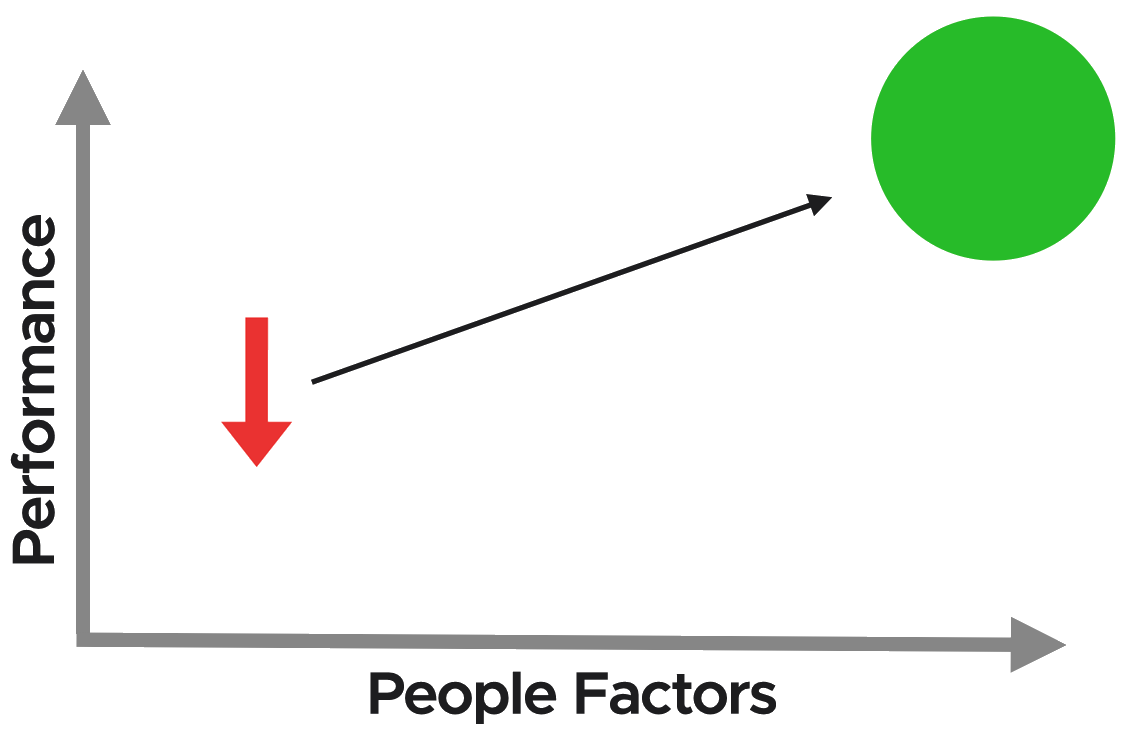
Studying the impact of leadership on performance began in the 1870s and was used to make significant strides in productivity. Since then, the workforce has evolved from manual labour to mind-based labour. Linear leadership has not kept pace.
Organisations can no longer afford leadership that fails to understand how critical the creative and collaborative needs of their people are to performance.
Retention is at the forefront
Modern jobs and tools continue to become more sophisticated. It now takes more time and money to hire and fully on-board new staff. The increased value of relationships and intellectual property significantly drive up the costs of an employee departure. In addition, employees have recently re-prioritised their quality of life. They are less willing to work in zero-sum linear leadership environments.
More than ever before, employers need to find leaders that can build teams where people love to work.
The need for innovation is everywhere
Innovation—whether inventing new products or solving a customer problem on-the-fly—is more important to organisations than ever.
But innovation is a delicate thing. It requires leaders who nurture communication, creativity and collaboration.
Organisations now need these leaders everywhere.
Wellbeing, DEI and psychological safety are essential
The last decade proved that the impact of “soft” skills is rooted in hard science. Wellbeing, psychological safety and DEI&B (diversity, equity, inclusion and belonging) strongly influence financial performance, customer satisfaction and employee retention.
Staying competitive requires that leaders shift their approach. Leaders must learn how to understand and unlock the full potential of these vital human needs.
Employers operate in a fishbowl
The Internet and social media make an employer’s reputation transparent to everyone. Potential employees can now assess—and eliminate—possible employers early in their decision-making.
An employer must embrace people-first policies across its leadership ranks so that it can find the best people to hire.